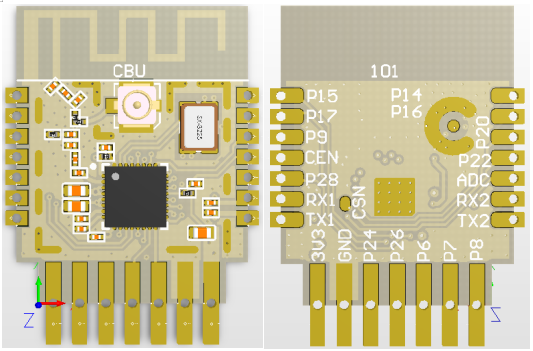
CBU is a low-power embedded Wi-Fi module that Tuya has developed. It consists of a highly integrated RF chip BK7231N and a few peripherals, and not only supports the AP and STA dual-network-connection manner but supports the Bluetooth LE network connection manner.
CBU is built-in with a 32-bit MCU with a running speed of up to 120 MHz, 2Mbyte flash, and 256-KB RAM, so as to support the multi-cloud connection. The MCU’s specially extended instructions for processing signals can effectively implement audio encoding and decoding. Besides, it has rich peripherals, such as PWM, UART, and SPI. The six 32-bit PWM output makes the chip very suitable for high-quality LED control.
| Update date | Updated content | Version after update |
|---|---|---|
| 10/16/2020 | This is the first release. | V1.0.0 |
| 11/24/2020 | Updated test data | V1.0.1 |
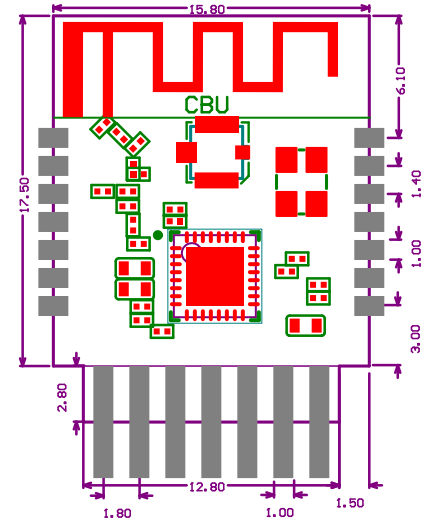
The CBU dimensions are 15.8±0.35 mm (L)×20.3±0.35 mm (W) ×2.7±0.1 mm (H). The dimensions of CBU are as follows:
| Pin number | Symbol | I/O type | Function |
|---|---|---|---|
| 1 | P14 | I/O | Common GPIO, which can be reused as SPI_SCK |
| 2 | P16 | I/O | Common GPIO, which can be reused as SPI_MOSI |
| 3 | P20 | I/O | Common GPIO |
| 4 | P22 | I/O | Common GPIO |
| 5 | ADC | I/O | ADC, which corresponds to P23 on the internal IC |
| 6 | RX2 | I/O | UART_RX2, which corresponds to P1 on the internal IC |
| 7 | TX2 | I/O | UART_TX2, which is used for outputting logs and corresponds to P0 of the internal IC |
| 8 | P8 | I/O | Support hardware PWM |
| 9 | P7 | I/O | Support hardware PWM |
| 10 | P6 | I/O | Support hardware PWM |
| 11 | P26 | I/O | Support hardware PWM |
| 12 | P24 | I/O | Support hardware PWM |
| 13 | GND | P | Power supply reference ground |
| 14 | 3V3 | P | Power supply 3V3 |
| 15 | TX1 | I/O | UART_TX1, which is used for transmitting user data and corresponds to P11 of the internal IC |
| 16 | RX1 | I/O | UART_RX1, which is used for receiving user data and corresponds to P10 of the internal IC |
| 17 | P28 | I/O | Common GPIO |
| 18 | CEN | I/O | Reset pin |
| 19 | P9 | I/O | Support hardware PWM |
| 20 | P17 | I/O | Common GPIO, which can be reused as SPI_MISO |
| 21 | P15 | I/O | Common GPIO, which can be reused as SPI_CS |
| Test point | CSN | I/O | Mode selection pin. If connected to the ground before powered on, enter the firmware test mode. If not connected or connected to VCC before powered on, enter the firmware application mode Correspond to P21 on the internal IC. |
Note: P indicates a power supply pin and I/O indicates an input/output pin.
| Parameter | Description | Minimum value | Maximum value | Unit |
|---|---|---|---|---|
| Ts | Storage temperature | -55 | 125 | ℃ |
| VBAT | Power supply voltage | -0.3 | 3.9 | V |
| Static electricity discharge voltage (human body model) | TAMB-25℃ | -4 | 4 | KV |
| Static electricity discharge voltage (machine model) | TAMB-25℃ | -200 | 200 | V |
| Parameter | Description | Minimum value | Typical value | Maximum value | Unit |
|---|---|---|---|---|---|
| Ta | Working temperature | -40 | - | 105 | ℃ |
| VBAT | Power supply voltage | 3.0 | 3.3 | 3.6 | V |
| VOL | I/O low level output | VSS | - | VSS+0.3 | V |
| VOH | I/O high level output | VBAT-0. 3 | - | VBAT | V |
| Imax | I/O drive current | - | 6 | 20 | mA |
| Working status | Mode | Rate | Transmit power/receive | Average value | Peak value (Typical value)) | Unit |
|---|---|---|---|---|---|---|
| Transmit | 11b | 11Mbps | +16dBm | 270 | 304 | mA |
| Transmit | 11g | 54Mbps | +15dBm | 260 | 280 | mA |
| Transmit | 11n | MCS7 | +14dBm | 253 | 273 | mA |
| Receive | 11b | 11 Mbps | Constantly receive | 73 | 82 | mA |
| Receive | 11g | 54 Mbps | Constantly receive | 75 | 82 | mA |
| Receive | 11n | MCS 7 | Constantly receive | 75 | 82 | mA |
| Working mode | Working status, Ta = 25°C | Average value | Maximum value (Typical value) | Unit |
|---|---|---|---|---|
| Quick network connection state (Bluetooth ) | The module is in the fast network connection state and the Wi-Fi indicator flashes fast | 70 | 270 | mA |
| Quick network connection state (AP) | The module is in the hotspot network connection state and the Wi-Fi indicator flashes slowly | 80 | 305 | mA |
| Quick network connection state (EZ) | The module is in the fast network connection state and the Wi-Fi indicator flashes fast | 87 | 380 | mA |
| Network connection state | The module is connected to the network and the Wi-Fi indicator is always on | 39 | 355 | mA |
| Parameter | Description |
|---|---|
| Working frequency | 2.412 to 2.480 GHz |
| Wi-Fi standard | IEEE 802.11 b/g/n (channels 1 to 14) |
| Data transmission rate | 11b: 1, 2, 5.5, 11 (Mbps); 11g: 6, 9, 12, 18, 24, 36, 48, 54 (Mbps); 11n: HT20 MCS0~7; 11n: HT40 MCS 0 to 7 |
| Antenna type | PCB or FPC antenna |
| Parameter | Minimum value | Typical value | Maximum value | Unit |
|---|---|---|---|---|
| Average RF output power, 802.11b CCK Mode 11M | - | 16 | - | dBm |
| Average RF output power, 802.11g OFDM Mode 54M | - | 15 | - | dBm |
| Average RF output power, 802.11n OFDM Mode MCS7 | - | 14 | - | dBm |
| Frequency error | -20 | - | 20 | ppm |
| Parameter | Minimum value | Typical value | Maximum value | Unit |
|---|---|---|---|---|
| PER<8%, RX sensitivity, 802.11b DSSS Mode 11M | - | -88 | - | dBm |
| PER<10%, RX sensitivity, 802.11g OFDM Mode 54M | - | -74 | - | dBm |
| PER<10%, RX sensitivity, 802.11n OFDM Mode MCS7 | - | -72 | - | dBm |
| PER<10%, RX sensitivity, Bluetooth LE 1M | - | -93 | - | dBm |
| Parameter | Minimum value | Typical value | Maximum value | Unit |
|---|---|---|---|---|
| Working frequency | 2402 | - | 2480 | MHz |
| Air rate | - | 1 | - | Mbps |
| TX power | -20 | 6 | 20 | dBm |
| Frequency error | -150 | - | 150 | kHz |
| Parameter | Minimum value | Typical value | Maximum value | Unit |
|---|---|---|---|---|
| RX sensitivity | - | -93 | - | dBm |
| Maximum RF signal input | -10 | - | - | dBm |
| Inter-modulation | - | - | -23 | dBm |
| Co-channel suppression ratio | - | 10 | - | dB |
The CBU may select the PCB or FPC antenna.
To ensure the optimal Wi-Fi performance when the Wi-Fi module uses an onboard PCB antenna, it is recommended that the antenna be at least 15 mm away from other metal parts.
To prevent an adverse impact on the antenna radiation performance, avoid copper or traces within the antenna area on the PCB.
Mount Tuya’s stamp hole package module with an SMT machine within 24 hours after unpacking and burning the firmware. Otherwise, the module must be packaged again under vacuum. The module must be baked before mounting.
Storage conditions for a delivered module are as follows:
The moisture-proof bag must be placed in an environment where the temperature is below 30°C and the relative humidity is lower than 70%.
The shelf life of a dry-packaged product is 6 months from the date when the product is packaged and sealed.
The package contains a humidity indicator card (HIC).
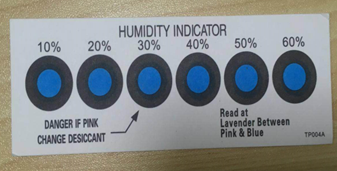
Bake a module based on HIC status as follows when you unpack the module package:
Baking settings:
Do not use SMT to process modules that have been unpacked for more than 3 months, because electroless nickel/immersion gold (ENIG) is used for PCBs and they are seriously oxidized for over 3 months. SMT is very likely to cause pseudo and missing soldering. Tuya is not liable for such problems and consequences.
Before using SMT, take electrostatic discharge (ESD) protective measures.
To reduce the reflow defect rate, draw 10% of the products for visual inspection and AOI before the first mounting, to determine the rationality of oven temperature control and component attachment and placement manners. Draw 5 to 10 modules from subsequent batches each hour for visual inspection and AOI.
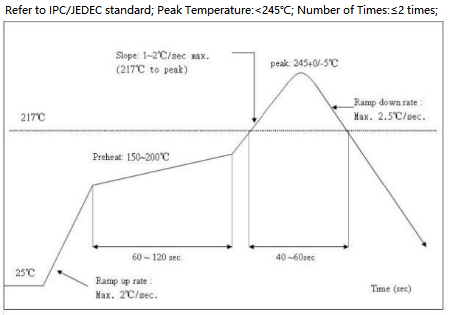
Perform SMT based on the following reflow oven temperature curve. The highest temperature is 245°C. The reflow temperature curve is as below:
| Product number | MOQ (pcs) | Shipping packaging method | The number of modules per reel | The number of reels per carton |
|---|---|---|---|---|
| CBU | 3600 | Tape reel | 900 | 4 |
FCC Caution: Any changes or modifications not expressly approved by the party responsible for compliance could void the user’s authority to operate this device.
This device complies with Part 15 of the FCC Rules. Operation is subject to the following two conditions: (1) This device may not cause harmful interference, and (2) this device must accept any interference received, including interference that may cause undesired operation.
Note: This device has been tested and found to comply with the limits for a Class B digital device, according to part 15 of the FCC Rules. These limits are designed to provide reasonable protection against harmful interference in a residential installation. This device generates, uses, and can radiate radio frequency energy and, if not installed and used following the instructions, may cause harmful interference to radio communications. However, there is no guarantee that interference will not occur in a particular installation.
If this device does cause harmful interference to radio or television reception, which can be determined by turning the device off and on, the user is encouraged to try to correct the interference by one or more of the following measures:
Radiation Exposure Statement
This device complies with FCC radiation exposure limits set forth for an uncontrolled rolled environment. This device should be installed and operated with a minimum distance of 20cm between the radiator and your body.
Important Note
This radio module must not be installed to co-locate and operating simultaneously with other radios in the host system except following FCC multi-transmitter product procedures. Additional testing and device authorization may be required to operate simultaneously with other radios.
The availability of some specific channels and/or operational frequency bands are country dependent and are firmware programmed at the factory to match the intended destination. The firmware setting is not accessible by the end-user.
The host product manufacturer is responsible for compliance with any other FCC rules that apply to the host not covered by the modular transmitter grant of certification. The final host product still requires Part 15 Subpart B compliance testing with the modular transmitter installed.
The end-user manual shall include all required regulatory information/warnings as shown in this manual, including “This product must be installed and operated with a minimum distance of 20 cm between the radiator and user body”.
This device has got an FCC ID: 2ANDL-CBU. The end product must be labeled in a visible area with the following: “Contains Transmitter Module FCC ID: 2ANDL-CBU”.
This device is intended only for OEM integrators under the following conditions:
The antenna must be installed such that 20cm is maintained between the antenna and users, and the transmitter module may not be co-located with any other transmitter or antenna.
As long as the 2 conditions above are met, further transmitter tests will not be required. However, the OEM integrator is still responsible for testing their end-product for any additional compliance requirements required with this module installed.
Declaration of Conformity European Notice

Hereby, Hangzhou Tuya Information Technology Co., Ltd declares that this module product is in compliance with essential requirements and other relevant provisions of Directive 2014/53/EU,2011/65/EU. A copy of the Declaration of conformity can be found at https://www.tuya.com.

This product must not be disposed of as normal household waste, in accordance with the EU directive for waste electrical and electronic equipment (WEEE-2012/19/EU). Instead, it should be disposed of by returning it to the point of sale, or to a municipal recycling collection point.
The device could be used with a separation distance of 20cm to the human body.