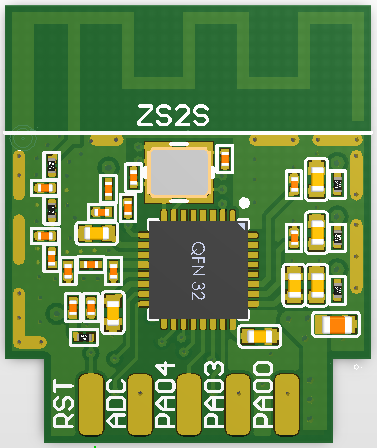
ZS2S is a low-power embedded Zigbee module that Tuya has developed. It consists of a highly integrated RF processor chip (EFR32MG21A020F768IM32-B) and several peripheral components, with an embedded 802.15.4 PHY/MAC Zigbee network protocol stack and robust library functions.
ZS2S is embedded with a 32-bit low-power Arm Cortex-M33 core, 768 KB flash memory, and 64 KB random-access memory (RAM), and has extensive peripherals.
| Date | Change Description | Version After Change |
|---|---|---|
| 20191210 | This is the first release. | V1.0.0 |
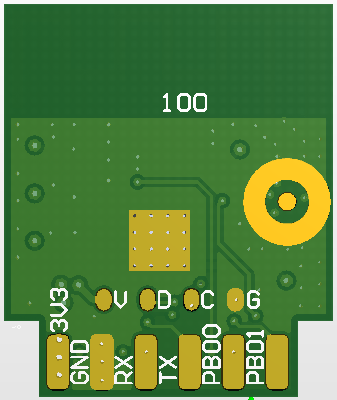
ZS2S has two rows of pins with a 2±0.1 mm pin spacing.
ZS2S dimensions (W x D x H) are 14.9 (±0.35) mm (W)×17.9 (±0.35) mm (L) ×2.8(±0.15) mm(H).Figure shows the ZS2S front and rear views.
| Pin No. | Symbol | I/O Type | Function |
|---|---|---|---|
| 1 | 3V3 | P | Power supply pin (typical power supply voltage: 3.3 V) |
| 2 | PA00 | I/O | Hardware PWM pin, which is connected to PA00 on the internal IC |
| 3 | GND | P | Power supply reference ground pin, which must be properly grounded |
| 4 | PA03 | I/O | Hardware PWM pin, which is connected to PA03 on the internal IC |
| 5 | RX | I/O | Serial interface receiving pin (UART0_RXD), which is connected to PA06 on the internal IC |
| 6 | PA04 | I/O | Hardware PWM pin, which is connected to PA04 on the internal IC |
| 7 | TX | I/O | Serial interface transmission pin (UART0_TXD), which is connected to PA05 on the internal IC |
| 8 | ADC | AI | ADC,which is connected to PC01 on the internal IC |
| 9 | PB00 | I/O | Hardware PWM pin, which is connected to PB00 on the internal IC |
| 10 | RST | I | Hardware reset pin (The chip is reset when the level is low. The level is high in |
| 11 | PB01 | I/O | Hardware PWM pin, which is connected to PB01 on the internal IC |
| Pin No. | Symbol | I/O Type | Function |
|---|---|---|---|
| 12 | V | P | Power supply pin (typical power supply voltage: 3.3 V) |
| 13 | D | I/O | JLINK SWDIO burning pin,which is connected to PA02 on the internal IC |
| 14 | C | I/O | JLINK SWCLK burning pin,which is connected to PA01 on the internal IC |
| 15 | G | P | Power supply reference ground pin, which must be properly grounded |
Note: P indicates a power supply pin, and I/O indicates an input/output pin.
| Parameter | Description | Minimum Value | Maximum Value | Unit |
|---|---|---|---|---|
| Ts | Storage temperature | -50 | 150 | ℃ |
| VCC | Power supply voltage | -0.3 | 3.8 | V |
| Static electricity voltage (human body model) | TAMB-25℃ | - | 2 | kV |
| Static electricity voltage (machine model) | TAMB-25℃ | - | 0.5 | kV |
| Parameter | Description | Minimum Value | Average Value | Maximum Value (Typical Value) | Unit |
|---|---|---|---|---|---|
| Ta | Working temperature | -40 | - | 85 | ℃ |
| VCC | Power supply voltage | 2.0 | 3.0 | 3.8 | V |
| VIL | I/O low-level input | - | - | IOVDD*0.3 | V |
| VIH | I/O high-level input | IOVDD*0.7 | - | - | V |
| VOL | I/O low-level output | - | - | IOVDD*0.2 | V |
| VOH | I/O high-level output | IOVDD*0.8 | - | - | V |
| Working Status | Rate | TX Power/Receiving | Average Value | Maximum Value (Typical Value) | Unit |
|---|---|---|---|---|---|
| TX | 250Kbps | +20dBm | 200 | 210 | mA |
| TX | 250Kbps | +10dBm | 62 | 64 | mA |
| TX | 250Kbps | +0dBm | 26 | 28 | mA |
| RX | 250Kbps | Constant receiving | 10 | 12 | mA |
| Working Mode | Working Status (Ta = 25°C) | Average Value | Maximum Value (Typical Value) | Unit |
|---|---|---|---|---|
| EZ | The module is in EZ mode. | 10 | 40 | mA |
| Connected and idle | The module is connected to the network. | 4.2 | 5 | mA |
| Deep sleep mode | The module is in deep sleep mode, with 64 KB flash memory. | 5 | - | μA |
| Parameter | Description |
|---|---|
| Frequency range | 2.4GHz ISM band |
| Zigbee standard | IEEE 802.15.4 |
| Data transmission rate | 250kbps |
| Antenna type | PCB antenna with a gain of 1 dBi |
| Parameter | Minimum Value | Average Value | Maximum Value (Typical Value) | Unit |
|---|---|---|---|---|
| Output power | -30 | 20 | - | dBm |
| Output power adjustment step | - | 0.5 | 1 | dB |
| Output spectrum adjacent-channel rejection ratio | - | -31 | - | dB |
| Frequency error | -15 | N/A | +15 | dB |
RX sensitivity
| Minimum Value | Average Value | Maximum Value (Typical Value) | Unit |
|---|---|---|---|
| RX sensitivity 250kbps | - | -102 | - |
ZS2S uses an PCB antenna, antenna gain is 1dBi.
To ensure optimal Zigbee performance when the Zigbee module uses a PCB antenna, it is recommended that the antenna be at least 15 mm away from other metal parts. To prevent adverse impact on the antenna radiation performance, avoid copper or traces along the antenna area on the PCB.
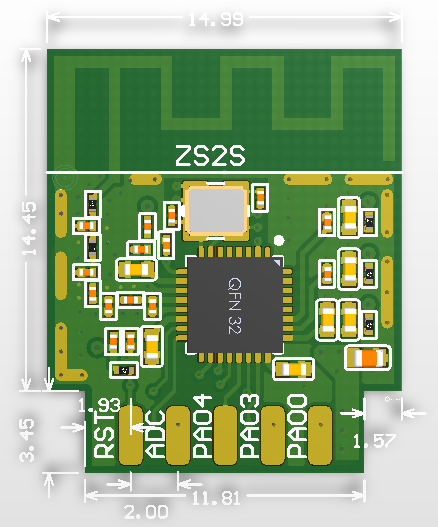
Note: The default tolerance of module overall dimension is ± 0.35 mm,Key dimension tolerance is ± 0.1 mm.If the customer has clear requirements for key dimensions,please make clear calibration in the specification after communication。
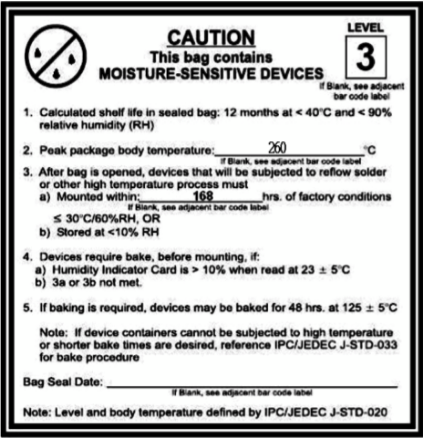
For the in-line module developed by Tuya, the wave soldering equipment is most preferred and manual soldering is less preferred. After being unpacked, the module must be soldered within 24 hours. Otherwise, it must be put into the drying cupboard where the RH is not greater than 10%, or it needs to be packaged under vacuum again and record the exposure time (the total exposure time cannot exceed 168 hours).
Soldering equipment and materials:
Baking equipment:
The module needs to be baked in the following cases:
Baking settings:
Temperature: 60°C and ≤ 5%RH for reelizing and 125°C and ≤5%RH for palletizing (please use heat-resistant pallet rather than plastic pallet)
Time: 48 hours for reelizing and 12 hours for palletizing
Alarm temperature: 65°C for reelizing and 135°C for palletizing
Production ready temperature after natural cooling: < 36°C
The number of drying times: 1
Re-baking requirement: If a module remains unused for 168 hours after being unpacked, it must be baked again.
Important: If this batch of modules is not baked within 168 hours, do not use the wave soldering to solder them. Because the modules are 3-level moisture-sensitive components, they are very likely to get damp when exposed outside. In this case, if they are soldered at high temperatures, it may result in component failure or poor soldering.
In the whole production process, take electrostatic discharge (ESD) protective measures.
To guarantee the quality of products, you must pay attention to the following items:
For oven temperature setting, refer to oven temperatures for wave soldering. The peak temperature is 260°C±5°C. The wave soldering temperature curve is shown below:
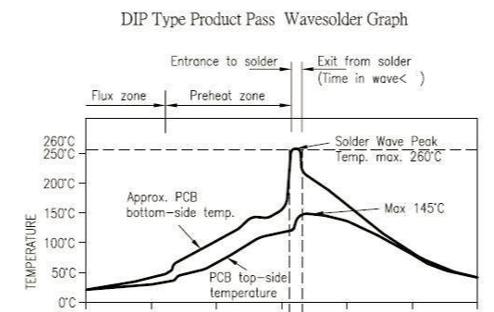
Recommended soldering temperature:
| Recommended wave soldering oven temperature | Recommended manual soldering temperature | ||
|---|---|---|---|
| Preheat temperature | 80 to 130 °C | Soldering temperature | 360±20°C |
| Preheat time | 75 to 100s | Soldering time | <3s/point |
| Peak contact time | 3 to 5s | NA | NA |
| Temperature of tin cylinder | 260±5°C | NA | NA |
| Ramp-up slope | ≤2°C/s | NA | NA |
| Ramp-down slope | ≤6°C/s | NA | NA |
Storage conditions for a delivered module are as follows:
The moisture-proof bag is placed in an environment where the temperature is below 40°C and the relative humidity is lower than 90%.
The shelf life of a dry-packaged product is 12 months from the date when the product is packaged and sealed.
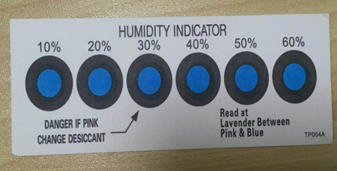
The package contains a humidity indicator card (HIC).
| Product Model | MOQ(pcs) | Packing Method | Number of Modules in Each Reel Pack | Number of Reel Packs in Each Box |
|---|---|---|---|---|
| ZS2S | 3600 | Carrier tape and reel packing | 900 | 4 |
FCC Caution: Any changes or modifications not expressly approved by the party responsible for compliance could void the user’s authority to operate this equipment.
This device complies with Part 15 of the FCC Rules.Operation is subject to the following two conditions: (1) This device may not cause harmful interference, and (2) this device must accept any interference received, including interference that may cause undesired operation.
Note: This equipment has been tested and found to comply with the limits for a Class B digital device, pursuant to part 15 of the FCC Rules.These limits are designed to provide reasonable protection against harmful interference in a residential installation. This equipment generates, uses and can radiate radio frequency energy and, if not installed and used in accordance with the instructions, may cause harmful interference to radio communications. However, there is no guarantee that interference will not occur in a particular installation. If this equipment does cause harmful interference to radio or television reception, which can be determined by turning the equipment off and on, the user is encouraged to try to correct the interference by one or more of the following measures:
Radiation Exposure Statement
This equipment complies with FCC radiation exposure limits set forth for an uncontrolled rolled environment. This equipment should be installed and operated with minimum distance 20cm between the radiator and your body.
Important Note
This radio module must not installed to co-locate and operating simultaneously with other radios in host system except in accordance with FCC multi-transmitter product procedures. Additional testing and equipment authorization may be required to operating simultaneously with other radio.
The availability of some specific channels and/or operational frequency bands are country dependent and are firmware programmed at the factory to match the intended destination. The firmware setting is not accessible by the end user.
The host product manufacturer is responsible for compliance to any other FCC rules that apply to the host not covered by the modular transmitter grant of certification. The final host product still requires Part 15 Subpart B compliance testing with the modular transmitter installed.
The end user manual shall include all required regulatory information/warning as shown in this manual, including: This product must be installed and operated with a minimum distance of 20 cm between the radiator and user body.
This device have got a FCC ID: 2ANDL-ZS2S.The final end product must be labeled in a visible area with the following: “Contains Transmitter Module FCC ID: 2ANDL-ZS2S”
This device is intended only for OEM integrators under the following conditions:
The antenna must be installed such that 20cm is maintained between the antenna and users, and
The transmitter module may not be co-located with any other transmitter or antenna.
As long as 2 conditions above are met, further transmitter test will not be required. However, the OEM integrator is still responsible for testing their end-product for any additional compliance requirements required with this module installed.
Declaration of Conformity European notice

Hereby, Hangzhou Tuya Information Technology Co., Ltd declares that this module product is in compliance with essential requirements and other relevant provisions of Directive 2014/53/EU,2011/65/EU.A copy of the Declaration of conformity can be found at https://www.tuya.com

This product must not be disposed of as normal household waste, in accordance with EU directive for waste electrical and electronic equipment (WEEE- 2012/19/EU). Instead,it should be disposed of by returning it to the point of sale, or to a municipal recycling collection point.
The device could be used with a separation distance of 20cm to the human body.